Hydraulic Hand-Pump vs. Pneumatic vs. Electric Rosin Presses: Gauge Telemetry & Seal Maintenance
External hydraulic hand-pump presses paired with a liquid-filled PSI gauge (such as Dabpress 10T/12T and Lowtemp V2) deliver the highest tactile ramp sensitivity and lowest maintenance cost for both flower and bubble hash. Pneumatic and air-over-hydraulic presses (PurePressure Longs Peak, NugSmasher Pro) provide push-button repeatable production cycles for commercial labs, while bottle-jack presses without gauges are best reserved for small-batch cured flower.
Buying an expensive electric or un-gauged bottle-jack press that slams 12 tons onto a delicate 25u bubble hash bag with zero pressure telemetry -- or neglecting hydraulic oil bleeding until the ram creeps backward mid-press.
Selecting an actuation architecture with direct liquid-filled gauge telemetry, converting gauge PSI into exact True Bag PSI, and bleeding hydraulic cylinders with ISO VG 32/46 jack oil every 250 cycles.
Quantitative Engineering Specification Matrix
| Actuation Architecture | Pressure Telemetry Precision | Ramp Speed Control | Auxiliary Shop Equipment | 10-Year Seal Reliability | Ideal Operator Profile |
|---|---|---|---|---|---|
| Integrated Bottle Jack (No Gauge) | Low (Tactile Lever Feel Only) | Manual Lever | None (Self-Contained) | High ($35 Replacement Jack) | Entry Home Flower Pressers (<7g Bottle-Tech) |
| Cylinder + External Hydraulic Hand Pump & Gauge | Ultra-High (Direct PSI / Tonnage Dial) | Infinite Tactile Micro-Pumping | None (Quiet Tabletop Operation) | Ultra-High (Replaceable Couplers & Seals) | Prosumer & Craft Hash Makers (Best Value/Control) |
| Pneumatic Direct-Air Cylinder (PurePressure) | Ultra-High (Digital / Regulator PSI) | Programmable / Dual-Stage Regulator | Quiet Oil-Free Air Compressor (120-150 PSI) | High (Zero Hydraulic Oil in Cleanroom) | GMP Commercial Live Hash Rosin Labs |
| Air-Over-Hydraulic Foot Pump | High (Manifold Gauge) | Fast Foot-Pedal Actuation | Air Compressor (90-120 PSI) | Moderate-High | High-Volume Flower & Hash Production |
| All-Electric Linear Actuator / Hybrid | Moderate to High (Load Cell / Preset) | One-Button Automated Presets | Standard 110V/220V Wall Outlet | Moderate (Proprietary Motor/PCB Service) | Plug-and-Play Home Users Wanting Zero Pumping |
1. The Four Rosin Press Actuation Architectures Compared
Every rosin press in the RosinHub 40-Model Hardware Rank Index uses one of four mechanical actuation systems to multiply force between the heated platens:
- Integrated Hydraulic Bottle Jack (e.g., Dabpress 4T/6T, NugSmasher Mini/OG, Rositek RMP2): A vertical welded hydraulic bottle jack sits directly beneath the lower platen. It is compact, silent, and requires zero external hoses, but standard bottle jacks lack a pressure gauge -- meaning you cannot see whether you are applying 400 Bag PSI or 1,600 Bag PSI.
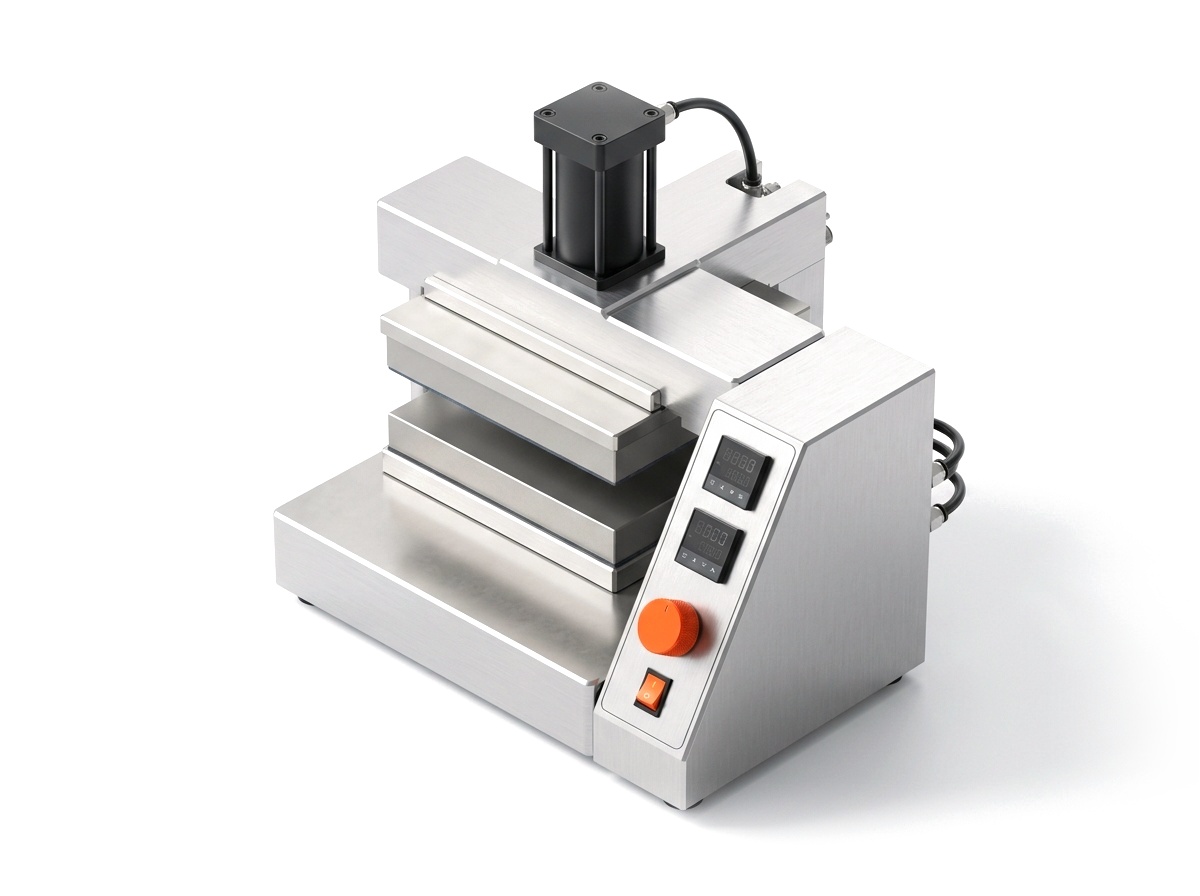
- Hydraulic Cylinder + External Hand Pump with Gauge (e.g., Dabpress 10T Driptech, Lowtemp V2 4x7, Sasquash M2): A low-profile hydraulic ram connects via a quick-disconnect high-pressure hose to an external hand pump equipped with a liquid-filled PSI/tonnage gauge. This is the overwhelming favorite of craft hash makers because you can feel the exact moment the hash patty wets out through the pump handle while watching the gauge needle hold 380 Bag PSI within +/- 10 PSI.
- Direct Pneumatic (Compressed Air) Cylinder (e.g., PurePressure Longs Peak & Pikes Peak V2): Uses a large-bore pneumatic cylinder driven by an external oil-free air compressor at 30 to 150 PSI. Because there is zero hydraulic oil inside the press, pneumatic systems are 100% cleanroom-compliant and allow two-stage programmable pressure recipes, though they cost $3,500 to $5,800 plus an air compressor.
- Electric / Electro-Hydraulic Actuation (e.g., NugSmasher IQ, Rosineer Presso Pro, Rositek NNP2): Uses an electric ball-screw linear actuator or internal electric hydraulic pump. Convenient for home tabletop use, but offers less tactile feedback during delicate 25u hash ramps.
2. How to Convert Hydraulic Gauge PSI to Ram Force (Lbs) & True Bag PSI
A common confusion on external hydraulic hand pumps (such as the BVA or Dabpress 10,000 PSI gauge) is mistaking Hydraulic Line PSI for Platen or Bag PSI. Inside a hydraulic cylinder, oil pressure (Line_PSI, typically 0 to 10,000 PSI) pushes against a steel piston of effective cross-sectional area A_piston (typically 2.0 to 2.25 square inches on a 10-ton cylinder): - Applied_Ram_Force_Lbs = Hydraulic_Line_PSI * Effective_Piston_Area_sqin - True_Bag_PSI = Applied_Ram_Force_Lbs / (Bag_Width_in * Bag_Length_in)
For example, on a 10-ton hydraulic cylinder where 9,000 Line PSI equals 20,000 lbs (10 tons) of full force (Piston_Area = 2.22 sq in), pumping the gauge to 1,500 Line PSI delivers 1,500 * 2.22 = 3,330 lbs (1.66 Tons) of force. If you are pressing bubble hash inside a 2.0 x 4.0 inch (8.0 sq in) bag, that 1,500 Line PSI reading equals 3,330 / 8.0 = 416 True Bag PSI -- right in the center of the 6-star hash sweet spot! Plug your press specs into the RosinHub Bag PSI Calculator to print a laminated gauge conversion sticker for your pump.
3. Preventative Maintenance: Bleeding Air, Platen Tramming & PID Calibration
Keep your press operating within 1% factory tolerance with three quarterly maintenance checks: - Bleed Trapped Air From Hydraulic Cylinders: If the ram feels spongy or takes 5 empty pump strokes before moving, open the release valve 2 turns, place the pump slightly higher than the cylinder, and pump 10 full strokes to purge air bubbles back into the reservoir. Top up exclusively with ISO VG 32 or VG 46 hydraulic jack oil (never brake fluid or motor oil, which dissolve nitrile O-rings). - Check Platen Parallelism (Tramming) With a 4-Corner Paper Drag Test: Cold-pinch four strips of parchment paper at the four corners of your platens at 100 lbs of force. All four strips should exhibit identical drag resistance. If one corner slips freely, adjust the guide-rod locknuts so pressure distributes evenly. - Verify Surface Temperature With a Type-K Surface Thermocouple Probe: Infrared laser thermometers read 15 F to 30 F too low on shiny 6061 aluminum platens due to low surface emissivity (epsilon = 0.09). Either place a piece of matte black electrical tape (epsilon = 0.95) on the platen face before aiming an IR gun, or press a flat-ribbon Type-K thermocouple probe between folded parchment sheets at 180 F and set your PID controller offset (Pb / SC) to match.
Standardized RosinHub Laboratory Telemetry & Verification Protocol
Every recommendation in this Hydraulic Hand-Pump vs. Pneumatic vs. Electric Rosin Presses: Gauge Telemetry & Seal Maintenance engineering guide (hydraulic vs pneumatic rosin press) is benchmarked against the standardized three-pillar telemetry framework used across the RosinHub 40-Model Hardware Rank & Review Index:
- True Bag-Level PSI Calibration (40% Scoring Weight): Rather than citing raw hydraulic ram tonnage or uncalibrated bottle-jack claims, all pressure targets in this guide are normalized to True Bag-Level PSI (
Force_Lbs / Compressed_Bag_Area_sqin). Whether you operate a compact 4-ton home press with 3x5 inch platens or a 20-ton commercial press with 4x7 inch platens, keeping the hydrostatic pressure inside the monofilament nylon weave within the exact target window prevents cuticular lipid co-extraction and eliminates ultrasonic seam blowouts. Verify your exact press-and-bag combination in 5 seconds using the Interactive Rosin Platen & Bag PSI Calculator. - Platen & Chamber Thermal Uniformity (35% Scoring Weight): Temperature setpoints are only meaningful when surface variation across the contact zone stays below
+/- 2.5 F (1.4 C). Single-heater platens and uninsulated thin aluminum plates suffer up to 18 F of perimeter heat drop during a 120-second press, causing resin to solidify prematurely at the bag edges. We test every platen face across a 9-point Type-K surface thermocouple grid under load. - Mass-Balance Yield & Payback Economics (25% Scoring Weight): Every extraction adjustment -- from dropping platen temperature by 8 F to switching from a 120u flower bag down to a 90u or 73u bag -- trades gross weight against terpene and cannabinoid purity. Model your exact biomass cost, wet-to-dry WPFF wash conversion, and hardware break-even timeline in the Wash-to-Rosin Yield & ROI Calculator and cross-check cultivar genetics in the 50-Strain WPFF Bubble Hash Wash Database.
By anchoring your solventless SOP to measurable physical units -- degrees Fahrenheit/Celsius at the platen-parchment interface, pounds per square inch at the compressed nylon footprint, equilibrium relative humidity (62% ERH), and micron pore diameter -- you eliminate batch-to-batch guesswork and reproduce commercial 6-star results on any calibrated press.
Step-by-Step Pre-Press & Post-Press Quality Control Checklist
Run this 8-point engineering quality control gate before and after every batch to lock in repeatable yields:
- Gate 1 -- Biomass Hydration & Temperature Audit: For cured flower, verify 60% to 64% equilibrium relative humidity (ERH) inside a sealed jar for at least 36 hours before molding. For WPFF bubble hash or dry sift, verify anhydrous dryness (
<1.2% moisturevia the 300 F hot-knife sizzle check) and load bags in a chilled environment (<55 F) so trichome heads stay free-flowing. - Gate 2 -- Micron Mesh & Seam Orientation: Inspect every monofilament nylon bag before loading. Turn single-layer flower bags (73u, 90u, 120u) inside-out so the ultrasonic weld sits inside the puck, and always double-bag bubble hash or dry sift (25u or 37u inner envelope + 160u structural outer sleeve with opposing fold seams).
- Gate 3 -- Platen Perimeter Clearance Check: Confirm at least 0.50 to 0.75 inches of bare heated platen clearance around all four edges of the loaded bag so expanding nylon never overhangs the heated zone.
- Gate 4 -- Zero-Pressure Thermal Soak ('Kiss Contact'): Bring the platens into light contact (
<50 Bag PSI) for 30 to 45 seconds until the nylon perimeter visibly darkens with melted resin before ramping hydraulic pressure. - Gate 5 -- Laminar Pressure Ramp & Gauge Hold: Ramp smoothly over 45 to 60 seconds to your calculated target (300-500 Bag PSI for bubble hash; 400-700 Bag PSI for dry sift; 650-1,050 Bag PSI for cured flower). Never exceed 1,150 Bag PSI.
- Gate 6 -- Cold-Plate Collection & Immediate Jar Seal: Remove the parchment sheet immediately at the end of the dwell timer, transfer onto a chilled aluminum collection plate, and seal inside a thick-walled borosilicate or Miron UV glass jar with a PTFE-lined cap within 3 minutes.
- Gate 7 -- Post-Press Curing or Decarboxylation Routing: Route dabbable jars to a 64 F Cold Cure (72-120h) or 205 F -> 98 F Warm Jam Cure; route 25u vape batches to a 155 F (68 C) sealed-jar partial decarboxylation before injecting into postless ceramic vape hardware.
- Gate 8 -- Spent Puck & Mass-Balance Logging: Weigh your starting biomass, finished rosin, and spent puck to log exact net return percentage, and store all spent flower pucks and hash bags in a freezer jar for 240 F decarboxylation and MCT coconut oil edible recovery using standard 0.877 molar THCA-to-THC stoichiometry.
Interactive Solventless Engineering Workbench
Interactive Rosin Platen & Bag Footprint PSI Calculator
Calculate both Platen-Level PSI and True Bag-Level PSI. Hydraulic gauge pressure is NOT bag PSI: a 10-ton press on a 2x4 inch bag delivers 2,500 PSI at the mesh, which will cause an instant blowout unless throttled.
- Flower Rosin Temperature, Time & Platen PSI Master Chart (77 C to 104 C / 170 F to 220 F) (2397 words)
- Hash Rosin vs. Flower Rosin: Complete Yield, Purity, Micron & Cost-Per-Gram Comparison (2290 words)
- Rosin Micron Bag Complete Guide: 25u, 37u, 73u, 90u, 120u, 160u Mesh Selection & Blowout Prevention (2377 words)
- Bottle Tech vs. Chottle Tech vs. Flat Envelope Fold: Platen Area & True Bag PSI Math (2342 words)
- Ice-Water Bubble Hash Washing SOP for 6-Star Full-Melt Live Rosin (WPFF 33 F Protocol) (2082 words)
- Freeze Dryer vs. Air Drying Bubble Hash: Shelf Temps, Sublimation Curves & Oxidation Control (2041 words)
- Cold Cure Badder vs. Warm Cure Rosin Jam & THCA Sauce: Jar Tech Nucleation Kinetics (2123 words)
- Solventless Live Rosin Vape Cart Partial Decarb Protocol (65 C / 150 F Sealed Jar SOP) (1956 words)
- Why 62% Relative Humidity Doubles Flower Rosin Yield: Cuticle Plasticization & Steam-Drive Physics (1790 words)
- Hydraulic Hand-Pump vs. Pneumatic vs. Electric Rosin Presses: Gauge Telemetry & Seal Maintenance (1923 words)
- Solventless THCA Diamond & High-Terpene Fraction (HTFSE) Mechanical Separation Protocol (25u Step-Ramp) (1816 words)
- Static Tech & LPI Screen Dry Sift Cleaning SOP: Pressing 99% Pure Heads Without Ice Water (1654 words)
- How to Recover Residual THC from Spent Rosin Pucks: Stoichiometric Decarb & MCT Lipid Infusion Math (1614 words)
- Commercial Solventless Lab Floor Plan, Cold-Room HVAC & 12-Month Equipment ROI Blueprint (1508 words)
- Live Rosin Quartz Banger Thermodynamics: IR Thermometer Temps (450 F - 520 F) Without Chazzing (1555 words)
- Long-Term Live Rosin Cold Storage: Headspace Oxygen, Miron UV Glass & Terpene Volatilization Kinetics (1561 words)
- Bubble Hash & Freeze Dryer Quick SOP
- Rosin Bags Micron Quick Chart
- Rosin Vape Pen Cartridge Quick Guide